Service Dog Training in North Carolina: Laws, Programs and Costs
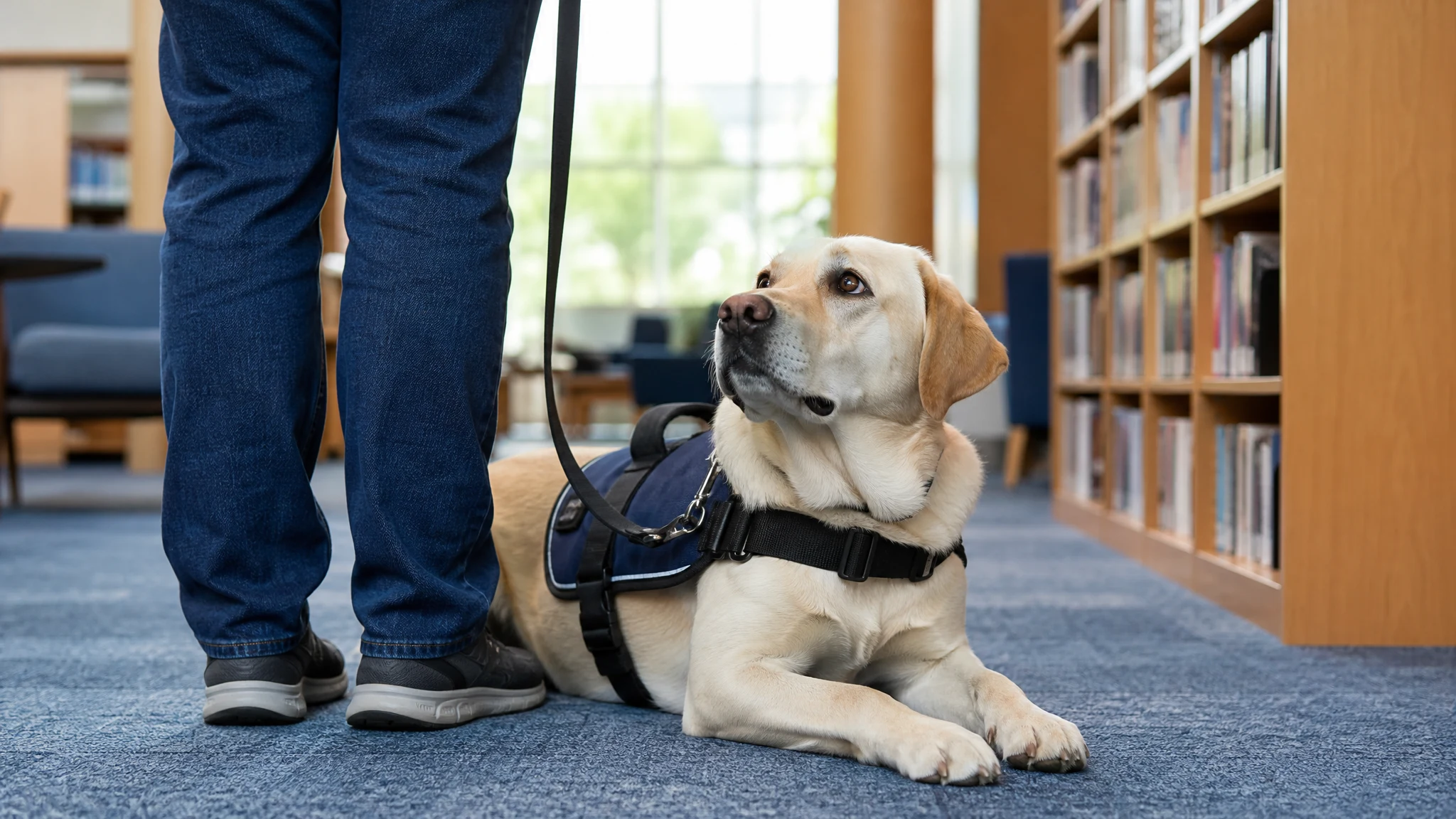
This page explains the law in general terms. It is not legal advice. For a specific situation, contact the agency listed on this site or an attorney.
A service dog can change daily life for a person with a disability. Getting one is a big project, and the rules come from two places: the federal Americans with Disabilities Act (ADA) and North Carolina statutes. This guide explains both in plain English. It also covers the two main routes to a dog, what training involves, what is known about costs, and the North Carolina organizations that place or train assistance dogs.
This is general information, not legal advice. Where the details matter, the guide points you to the agency or organization that can answer.
Key Takeaways
- Under the ADA.gov Service Animals FAQ, a service animal is a dog that has been individually trained to do work or perform tasks for a person with a disability.
- Emotional support, therapy and comfort animals are not service animals under the ADA.
- There is no official ADA registry or required certification for service dogs. Online registrations and ID cards are not legal proof.
- North Carolina law (G.S. 168-4.2) lets a person with a disability be accompanied by a service animal in the places listed in G.S. 168-3, and it covers animals in training.
- Disguising an animal as a service animal is a Class 3 misdemeanor under G.S. 168-4.5.
- There are two routes: a dog trained by a program, or a dog you train yourself, with or without a trainer's help.
- Costs vary. Two North Carolina programs say their dogs are provided at no cost to Veterans. For other programs, ask the organization directly.
Table of Contents
- What Counts as a Service Dog
- North Carolina Law: Access, Training and Penalties
- How to Get a Service Dog in North Carolina: Two Routes
- What Service Dog Training Involves
- Costs and What to Ask About Them
- North Carolina Organizations
- Housing, Work and Where to Go with Problems
- Where to Start
What Counts as a Service Dog
The word "service dog" gets used loosely. The legal meaning is narrower, and the difference matters for access rights.
The ADA definition
The ADA.gov Service Animals FAQ says a service animal is a dog that has been individually trained to do work or perform tasks for an individual with a disability. Two parts of that sentence do most of the work:
- Individually trained. The dog is taught specific behaviors, not just good manners.
- Work or tasks. The dog does something that helps with the person's disability.
Examples of tasks include guiding a person who is blind, alerting a person who is deaf, pulling a wheelchair, alerting to a medical event, or interrupting a harmful behavior. The disability can be physical, sensory, psychiatric, intellectual or mental.
What does not count
Under the ADA, emotional support animals, therapy animals and comfort animals are not service animals. A pet that gives comfort by being present is not doing trained work or tasks. These animals can be wonderful for their people, but the ADA does not give them the same public access rights.
A dog that has been trained to perform a task, such as a dog trained to interrupt a panic attack or remind someone to take medication, is different. That is trained work tied to a disability.
No registry, no required certificate
There is no official service dog registry and no required certification under the ADA. You do not need to register or certify your dog to have a service dog. Websites that sell registrations, certificates, vests or ID cards are not government agencies, and what they sell is not legal proof that a dog is a service animal. Do not pay for one thinking it creates legal status.
What staff can ask
The ADA.gov Service Animals FAQ says staff at a business may ask only two questions:
- Is the dog a service animal required because of a disability?
- What work or task has the dog been trained to perform?
Staff cannot demand paperwork, ask about the person's diagnosis, or ask the dog to demonstrate its task. For the full federal guidance, read the ADA.gov Service Animals FAQ.
North Carolina Law: Access, Training and Penalties
North Carolina has its own statutes on service animals, found in Chapter 168, Article 1 of the General Statutes (G.S. 168-4.2 through 168-4.5). They sit alongside the ADA. The federal definition is the clearest guide to what counts as a service animal.
Public access: G.S. 168-4.2
According to the North Carolina General Assembly, G.S. 168-4.2 provides that a person with a disability may be accompanied by a service animal in the places listed in G.S. 168-3. The person qualifies in one of two ways: by showing a tag issued by the Department of Health and Human Services, or by showing that the animal is being trained or has been trained as a service animal.
The statute describes the animal as one trained to assist the person with a disability. It takes the meaning of "person with a disability" from G.S. 168A-3(7a). The text does not say "dogs only" and does not mention miniature horses. Because the state statute has no separate definition of its own, use the ADA definition when deciding what counts as a service animal.
No extra charge
Under G.S. 168-4.4, as summarized from the General Assembly's text, no extra compensation may be charged for the animal. Before you rely on exact wording, read the statute on ncleg.gov.
Animals in training: G.S. 168-4.2(b)
North Carolina covers animals that are still in training, which matters if you are training a dog yourself. According to G.S. 168-4.2(b), an animal in training may be taken into the places listed in G.S. 168-3 when it wears a collar and leash, harness, or cape identifying it as a service animal in training. The trainer is present with the animal and is liable for damage the animal causes.
The statute text reviewed does not state an age limit or restrict this to professional trainers. If you have a question about your situation, check the statute and ask the agency listed later in this guide.
The optional state tag: G.S. 168-4.3
G.S. 168-4.3 sets up voluntary registration. The Department of Health and Human Services issues a tag, and the statute provides no fee for the application, registration, tag or replacement. Whether the department currently operates this program has not been confirmed, so contact the Department of Health and Human Services before counting on a tag. It is voluntary, and you do not need to buy anything from a private seller.
Misrepresentation: G.S. 168-4.5
G.S. 168-4.5 makes it unlawful to disguise an animal as a service animal or as a service animal in training. A violation is a Class 3 misdemeanor. A vest on a pet dog does not make it a service dog, and passing it off as one can carry a criminal penalty in North Carolina.
| Topic | What the source says | Source |
|---|---|---|
| Definition | A dog individually trained to do work or perform tasks for a person with a disability | ADA.gov Service Animals FAQ |
| Public access | Person may be accompanied by a service animal in places listed in G.S. 168-3 | G.S. 168-4.2 |
| In training | Allowed with identifying collar and leash, harness or cape; trainer present and liable for damage | G.S. 168-4.2(b) |
| State tag | Voluntary; no statutory fee; current operation not confirmed | G.S. 168-4.3 |
| Disguising an animal | Unlawful; Class 3 misdemeanor | G.S. 168-4.5 |
How to Get a Service Dog in North Carolina: Two Routes
People ask how to get a service dog in North Carolina, and there is no single path. Broadly, there are two: a dog trained and placed by an organization, or a dog you train yourself. Many people use a mix, such as an owner-trained dog with help from a private trainer.
Route one: a program-trained dog
In this route, a nonprofit or training organization selects and trains a dog, then matches it with a person. You usually apply, and the organization decides whether you fit its program. Many programs focus on one group, such as Veterans or people with a particular type of disability.
Possible advantages:
- The organization handles dog selection and most of the early training.
- Trainers can match the dog's tasks to your needs.
- Some programs offer follow-up support after placement.
Possible drawbacks:
- Programs set their own eligibility rules, and you may not qualify for every one.
- Waiting times can be long. The waitlist length for the North Carolina programs in this guide could not be confirmed, so ask each one.
- Costs differ from one program to the next.
Route two: an owner-trained dog
The ADA does not require that a service dog be trained by a professional program. A person with a disability can train their own dog to do work or tasks. North Carolina's in-training provision in G.S. 168-4.2(b) also covers an animal being trained, as long as the rules above are met.
Possible advantages:
- You choose the dog and set the training pace.
- You can tailor tasks to your exact needs.
- You are not tied to a program's waitlist.
Possible drawbacks:
- The work is demanding and takes months to years.
- Not every dog is suited to service work. Temperament matters, and some dogs will not be able to finish.
- You carry the responsibility for the dog's behavior in public, including liability for damage under G.S. 168-4.2(b) while the dog is in training.
Choosing between them
Think about your health, your energy and your support at home. Ask whether you can commit to daily training, whether a program serves your disability, and how much waiting you can handle. A conversation with your health care provider about how a dog could help with your specific needs is a sensible early step.
What Service Dog Training Involves
Training has three layers: basic manners, public access skills, and disability-specific tasks. All three have to be solid for a dog to work reliably.
Humane, reward-based methods
Good service dog training is reward-based. This matches the position of the American Veterinary Society of Animal Behavior (AVSAB), which supports reward-based methods and cautions against aversive tools and dominance-based approaches. Shock, prong and choke collars, alpha rolls and scruffing are not part of good training. A dog that works because it is stressed or afraid is less reliable, and the work should be a good experience for the dog too.
Layer one: foundation manners
- Sit, down, stay, come and loose-leash walking.
- Settling calmly on a mat for long periods.
- Leaving food, dropped items and other dogs alone on cue.
- Staying relaxed while being handled, groomed and examined.
- Toileting on cue so outings are manageable.
Layer two: public access skills
Service dogs work in busy places: stores, clinics, buses, restaurants and offices. A dog needs to ignore people, smells, sounds and dropped food. It should ride quietly in vehicles, handle elevators and stairs, and stay under or beside a seat. Training is gradual: start in quiet places and add distractions slowly, ending each session while the dog is still doing well.
Under the ADA.gov Service Animals FAQ, a business may ask a service dog to leave if it is out of control and the handler does not take effective action, or if it is not housebroken. Public access training is how a dog avoids that outcome.
Layer three: task training
Tasks depend on the person's disability. Examples include:
- Mobility: retrieving dropped items, opening doors, bracing or providing balance support.
- Medical alert and response: alerting to a medical event, such as a seizure or a blood sugar change, or fetching help.
- Hearing: alerting to sounds such as doorbells, alarms or a name being called.
- Psychiatric and PTSD support: tasks such as interrupting repetitive behaviors, creating space in a crowd, or turning on lights.
Trainers usually break each task into small steps, mark and reward correct behavior, then add cues and real-world conditions. Keep notes of what the dog has been trained to do. You may need to describe your dog's tasks if someone asks the second ADA question.
Working with a trainer
If you hire a trainer for an owner-trained dog, ask about their methods first. Look for reward-based training and clear answers about their experience with assistance dogs. Be careful with anyone who promises results or sells a certificate. Training outcomes depend on the dog, the handler and the work put in. This guide does not recommend or evaluate any individual trainer.
Costs and What to Ask About Them
Cost is one of the biggest questions, and the honest answer is that it depends on the route and the organization. No single typical North Carolina price can be given here, and any figure should come from the program or trainer itself.
What the North Carolina sources say
- Canines for Service in Wilmington says its dogs are provided at no cost to Veterans.
- Continuing the Mission says it provides fully trained assistance dogs at no cost to the Veteran.
- Eyes Ears Nose and Paws, paws4people and Vets to Vets United: costs were not stated in the sources reviewed. Contact each organization.
- State tag: G.S. 168-4.3 provides no fee for the application, registration, tag or replacement, subject to the program being operating.
What you may pay for in either route
Even when a dog is provided at no cost, ask what else you will be responsible for. Possible costs to ask about:
- Application, training or placement fees.
- Travel to training sessions or team training.
- Food, routine veterinary care, vaccines and preventive medicine.
- Equipment such as harnesses, leashes and grooming supplies.
- Private trainer fees, if you train the dog yourself.
- Replacement or retraining if a dog cannot continue working.
Under G.S. 168-4.4, a business cannot charge extra for your service animal. That rule is about access, not about what training costs.
Questions to ask any program
- Who is eligible, and what documentation do you need from me?
- What does the total cost to me include, and what does it leave out?
- How long is the waitlist right now?
- What tasks do your dogs learn, and how do you match a dog to a person?
- What training methods do you use?
- What follow-up support do you offer after placement?
North Carolina Organizations
The organizations below come from the sources reviewed for this guide. Listing them is not an endorsement or a recommendation, and this guide has not tested or reviewed their programs. Waitlist information was not available for any of them, so contact each directly before making plans. Programs may change their eligibility and fees over time.
| Organization | Location | Who it serves | Cost information |
|---|---|---|---|
| Canines for Service, Inc. | Wilmington | Veterans with PTSD, traumatic brain injury and mobility needs | Provided at no cost to Veterans |
| Eyes Ears Nose and Paws | Hillsborough (the Assistance Dogs International directory lists Chapel Hill) | Adults and children; mobility, medical alert, diabetes, seizures | Check with the organization |
| paws4people | Wilmington | Autism, dementia, diabetes, mobility, PTSD (civilian and military), psychiatric, seizures, hearing; veterans, first responders, children | Check with the organization |
| Continuing the Mission | Check with the organization | Veterans with PTSD | Fully trained assistance dogs at no cost to the Veteran |
| Vets to Vets United | Durham | Veterans with PTSD, traumatic brain injury or physical disability | Check with the organization |
Accreditation
Canines for Service, Eyes Ears Nose and Paws, and paws4people are listed as accredited by Assistance Dogs International (ADI). Accreditation is one thing a person can look at when comparing programs. It is not a legal requirement for a service dog under the ADA, and a dog from a non-accredited source can still qualify if it is individually trained to do work or tasks.
Veteran-focused options
Several North Carolina groups focus on Veterans:
- Canines for Service is a Wilmington nonprofit that places service dogs with Veterans with service-connected disabilities, including PTSD, military sexual trauma, traumatic brain injury and mobility needs, at no cost to Veterans.
- Continuing the Mission provides fully trained assistance dogs at no cost to Veterans in North Carolina. Its site states a goal of at least four to five dogs per year, which shows how limited placements can be.
- Vets to Vets United is a Durham nonprofit founded in 2012 that pairs Triangle-area veterans with rescue dogs. Veteran and dog teams complete training together, and the program is exclusively for U.S. military veterans.
The U.S. Department of Veterans Affairs also has a policy page stating that service dogs of all breeds are allowed in VA facilities. That is an access policy, not a placement program. Read it at VA.gov.
No North Carolina state veterans department service dog program was found in the sources reviewed. If you are a Veteran, ask the programs above or your VA care team what help is available.
Housing, Work and Where to Go with Problems
Housing
The North Carolina Fair Housing Act, G.S. 41A-4, makes it unlawful to refuse reasonable accommodations for a handicapped person. The text reviewed does not mention assistance animals or service animals by name, so this guide does not claim that state law addresses them directly. For housing questions involving an assistance animal, contact the complaint agency below or the U.S. Department of Housing and Urban Development (HUD), which handles federal housing rules.
Employment
G.S. 168A-5, part of the Persons with Disabilities Protection Act, prohibits employment discrimination against qualified persons with disabilities. Reasonable accommodation duties appear in G.S. 168A-4(b). No service-animal-specific employment provision was found in the statutes reviewed. If you want to bring a service dog to work, talk with your employer about an accommodation and put the request in writing.
Air travel
Air travel with a service dog falls under U.S. Department of Transportation rules, not the ADA public access rules. Check with your airline and the Department of Transportation well before you fly.
Who handles complaints
The North Carolina Office of Administrative Hearings, Civil Rights Division (Human Relations Commission) is the state agency to start with:
- Address: 1711 New Hope Church Road, Raleigh, NC 27609
- Phone: 984-236-1850
- Housing complaints: [email protected]
- Website: oah.nc.gov/civil-rights-division
The division's page does not describe a complaint process for public accommodation or service dog access issues, so call before assuming it can take your case. For federal ADA questions, the ADA.gov Service Animals FAQ is the place to begin.
Where to Start
If you are thinking about how to get a service dog in North Carolina, work through the steps in order. You do not have to decide everything at once.
- Clarify the need. Write down which tasks a dog could do to help with your disability. A dog that only provides comfort is not a service animal under the ADA.
- Read the rules. Review the ADA.gov Service Animals FAQ and the North Carolina statutes, starting with G.S. 168-4.2.
- Pick a route. Decide whether to apply to a program, train a dog yourself, or combine both.
- Contact programs. Ask the organizations in this guide about eligibility, cost, waitlists and training methods. Several serve specific groups, so check that you fit.
- If owner-training, plan carefully. Choose a dog for temperament and health, use reward-based methods, and find a trainer whose methods you have checked. Remember that the dog in training must wear identifying gear to use the access provisions of G.S. 168-4.2(b), and that you are liable for damage.
- Skip the registry sites. Do not buy a certificate or registration. It has no legal weight under the ADA, and misrepresenting an animal is a crime under G.S. 168-4.5.
- Know where to turn. Keep the complaint agency's details handy in case you face access problems.
Training a service dog takes time and steady effort, and no program or method can promise how any individual dog will turn out. With the right information and realistic expectations, you can choose a route that fits your life and your needs.
Sources
- ADA.gov Service Animals FAQ
- North Carolina General Assembly, G.S. 168-4.2
- North Carolina General Assembly, G.S. 168-4.3
- North Carolina General Assembly, G.S. 168-4.5
- North Carolina General Assembly, G.S. 41A-4
- North Carolina General Assembly, G.S. 168A-5
- NC Office of Administrative Hearings, Civil Rights Division
- Assistance Dogs International, North Carolina member directory
- U.S. Department of Veterans Affairs, service dogs in VA facilities
- Canines for Service, Inc.
- Eyes Ears Nose and Paws
- paws4people
- Continuing the Mission
- Vets to Vets United