Service Dogs in Training in North Carolina: Do They Have Public Access?
This page explains the law in general terms. It is not legal advice. For a specific situation, contact the agency listed on this site or an attorney.
Yes, with conditions. The Americans with Disabilities Act (ADA) does not cover a dog that is still in training. North Carolina has its own statute that does. This guide walks through what that law says and how to follow it, so a North Carolina service dog in training can practice in public without trouble.
This is general information about the law, not legal advice. The statutes are short, so read them yourself using the links at the end.
The short answer
The ADA defines a service animal as a dog that has been individually trained to do work or perform tasks for a person with a disability, according to the ADA.gov Service Animals FAQ. That definition covers dogs that have already been trained. It does not give access rights to a dog that is still learning.
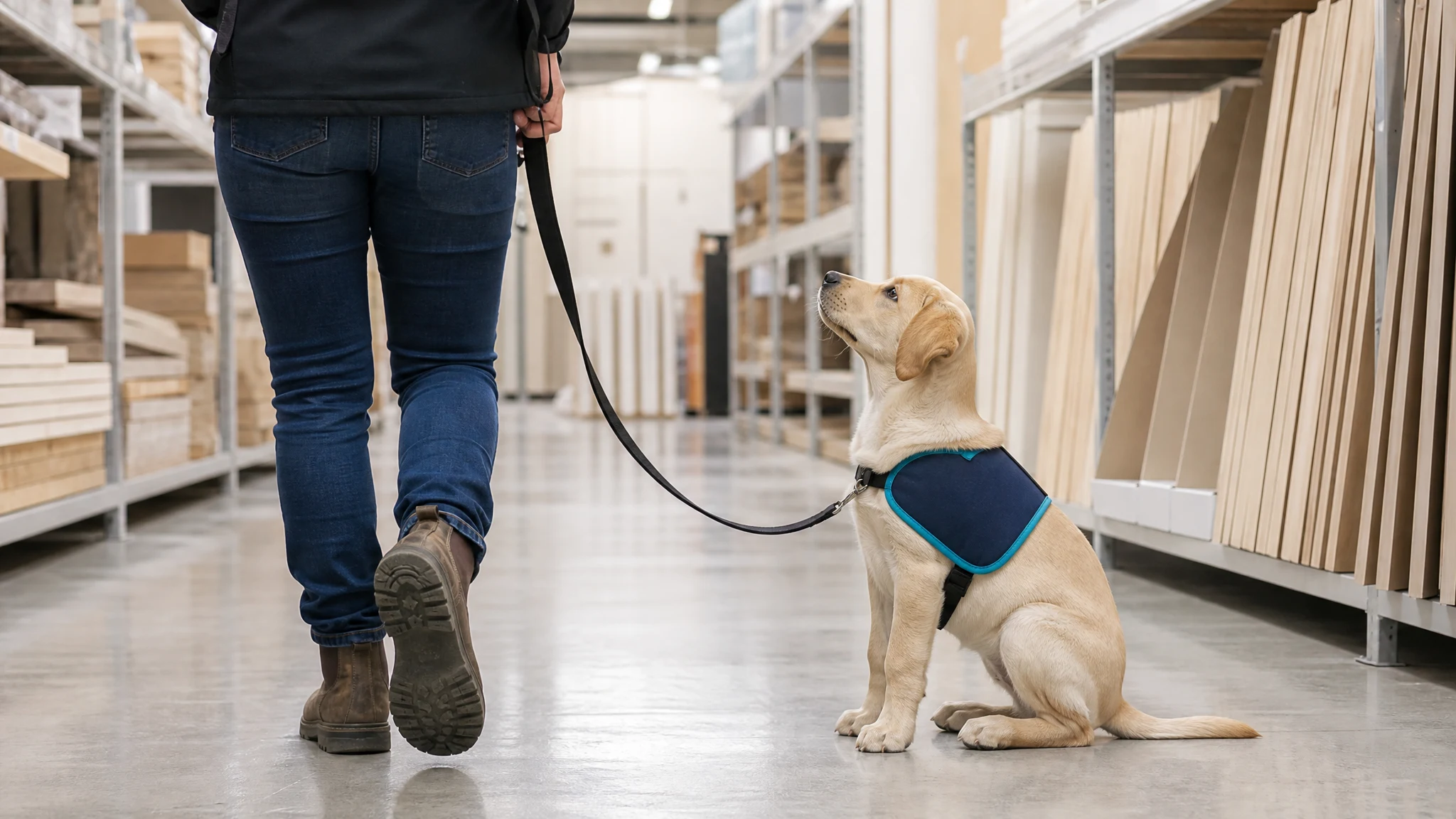
North Carolina fills part of that gap. N.C. Gen. Stat. 168-4.2(b) allows an animal in training to be taken into the places listed in G.S. 168-3. The animal must wear a collar and leash, a harness, or a cape that identifies it as a service animal in training. The trainer must be with the animal and is liable for any damage it causes.
That is the core of service dog in training rights in this state. The rest of this guide shows how to meet those conditions.
What you need before you start
- A dog that you are actually training to do work or tasks for a person with a disability.
- A collar and leash, a harness, or a cape that identifies the dog as a service animal in training. The statute accepts any of these.
- A copy, printed or on your phone, of G.S. 168-4.2 and G.S. 168-3 from the North Carolina General Assembly website.
- A reward-based training plan, with treats or toys the dog loves.
- A plan for covering damage the dog might cause. The statute makes the trainer liable, so check your own insurance with your insurer.
Step 1: Confirm the dog is really in training
The statute is built around an animal that is being trained as a service animal. The goal is a dog that does specific work or tasks tied to a disability. Comfort alone does not meet the ADA definition. The ADA says emotional support, therapy and comfort animals are not service animals.
A pet that goes along on errands is not in training under this law. North Carolina makes it unlawful to disguise an animal as a service animal or as a service animal in training. G.S. 168-5 lists the penalty as a Class 3 misdemeanor, and the citation in the statute is G.S. 168-4.5. Treat this as the line you do not cross.
Step 2: Understand who is covered
Many people assume only professional trainers get access. The statute text reviewed does not say that. G.S. 168-4.2(b) does not state an age limit, and it does not limit access to professional trainers. That means owner-trainers and people working with a program are not excluded by the wording of the statute.
The statute does require that the trainer be present with the animal. A dog cannot go into a store or restaurant on its own, and a trainer cannot send it with someone else.
If your situation is unusual, such as a very young handler or a dog placed with a family, check the statute and ask the agency listed in the last section. Do not assume the answer.
Step 3: Know where the law applies
G.S. 168-4.2(b) points to the places listed in G.S. 168-3. Open that section and read the list before you plan outings. The list sets where a dog in training may go under state law. Do not rely on a summary from anyone else, including this guide.
If a place is not on that list, North Carolina law does not give you a right to bring the dog in. That includes some private spaces. See Step 7 for what to do then.
Step 4: Put the right gear on the dog
The statute requires that the animal wear a collar and leash, a harness, or a cape that identifies it as a service animal in training. The gear needs to say so. A plain leash with no identification does not satisfy the wording as summarized.
- Choose a harness or cape with clear lettering such as "service dog in training."
- Fit it so it does not rub or restrict movement.
- Put it on only when you are doing real training outings. This helps the dog learn that the gear means work time.
- Use a flat collar or a front-clip or back-clip harness. Humane, reward-based methods are the standard recommended by the American Veterinary Society of Animal Behavior (AVSAB). Avoid shock, prong or choke collars.
Gear is not a certificate. It does not prove anything about the dog's skills, and it is not an official credential.
Step 5: Stay with the dog and keep control
The trainer must be present and is liable for damage under G.S. 168-4.2(b), as summarized. Plan every outing around that rule.
- Keep the dog on a leash or under your direct control at all times.
- Start with short, easy outings and build up slowly.
- Reward calm behavior: settling under a table, ignoring dropped food, walking past other dogs.
- End the outing early if the dog is stressed, overexcited or not ready. A short success teaches more than a long struggle.
- Take the dog outside to relieve itself before you go in.
A dog that barks, lunges, sniffs merchandise or has accidents can be asked to leave under general rules about behavior, even in a place where access is allowed. Business owners are generally entitled to expect that a dog is under control and housebroken. A calm dog is the best protection for your access.
Step 6: Handle questions from staff
For a fully trained service dog, the ADA lets staff ask only two questions, according to the ADA.gov Service Animals FAQ: whether the dog is a service animal required because of a disability, and what work or task the dog has been trained to perform. Those questions come from the ADA, and the ADA does not cover dogs in training.
For a dog in training, expect a slightly different conversation. Be polite and calm. You might say, "This is a service dog in training, and I am the trainer. North Carolina law allows it under G.S. 168-4.2." Keep it short and do not argue.
You do not need to carry a registration. The ADA has no official service dog registry and no required certification. A purchased certificate, ID card or online registration is not legal proof of anything. Do not buy one.
About the state tag
G.S. 168-4.2 says a person with a disability qualifies for access by showing a tag issued by the Department of Health and Human Services, or by showing that the animal is being trained or has been trained as a service animal. G.S. 168-4.3 describes a voluntary registration with DHHS, with no fee for the application, registration, tag or replacement. Whether DHHS currently runs that program is not something this guide can confirm. Contact DHHS before you count on a tag.
North Carolina also says no extra compensation may be charged for the animal under G.S. 168-4.4. Check the statute for the exact wording.
Step 7: Plan for places that are not covered
Some places will fall outside what the statute gives you. When that happens, North Carolina law does not grant access, and the ADA does not either for a dog still in training. In practice:
- Ask permission first. Call or speak to a manager before you arrive.
- Choose pet-friendly places for practice when you are not sure, such as outdoor patios and stores that welcome dogs.
- Accept a no. A business that refuses a dog in training may not be breaking North Carolina law if the place is not on the G.S. 168-3 list.
- Do not claim that the ADA protects a dog in training. It does not, and saying so can create conflict and weaken your case.
Housing and work are different topics. The North Carolina Fair Housing Act, G.S. 41A-4, makes it unlawful to refuse reasonable accommodations for a handicapped person, but the text does not name assistance animals or service animals. For employment, G.S. 168A-5 prohibits discrimination against qualified people with disabilities, and no service-animal-specific provision was found. If you need an answer about a landlord or employer, ask the agency below.
Tips and common mistakes
- Mistake: treating a pet as a trainee. Disguising an animal is a Class 3 misdemeanor under G.S. 168-4.5.
- Mistake: skipping the gear. The statute ties access to identifying gear.
- Mistake: buying a registry card. No registry or certification is required, and a purchased card is not legal proof.
- Mistake: going too fast. Taking an unready dog into a busy store invites problems and can set training back.
- Mistake: forgetting liability. The trainer is responsible for damage.
- Tip: Keep a note of each outing, what went well and what to work on.
- Tip: Read G.S. 168-3 once a year in case the list of places changes.
- Tip: Use rewards, not force. Pain or fear can make a dog reactive and unreliable in public.
What to expect
If you follow these steps, you may find that most businesses allow your dog in training without a fuss, and that outings go more smoothly as the dog gains experience. Results vary by dog, handler and location, and no outcome is certain. Some staff will not know the law, and some will say no even where the statute gives you access.
When that happens, stay calm and polite. You can offer the statute citation, leave if needed and report the problem later.
Where to ask or complain
The NC Office of Administrative Hearings, Civil Rights Division (Human Relations Commission) is at 1711 New Hope Church Road, Raleigh, NC 27609. Its phone number is 984-236-1850. Housing complaints can go to [email protected]. The agency's page does not describe a complaint process for public-accommodation service dog access, so call to ask what it can do before you file anything.
Programs that train assistance dogs in the state include ADI-accredited groups such as Canines for Service in Wilmington, Eyes Ears Nose and Paws in Hillsborough, and paws4people in Wilmington. Contact any of them directly for current details on how they handle training outings, since fees and waitlists were not confirmed.
Sources
- North Carolina General Assembly, G.S. 168-4.2
- North Carolina General Assembly, G.S. 168-4.3
- North Carolina General Assembly, G.S. 168-4.5
- North Carolina General Assembly, G.S. 41A-4
- North Carolina General Assembly, G.S. 168A-5
- ADA.gov Service Animals FAQ
- NC Office of Administrative Hearings, Civil Rights Division